Eastwind Systems

Health systems, built to run.

Eastwind Systems designs, builds and operates digital health systems for ministries, national institutes, agencies and humanitarian programmes in the Horn of Africa. Surveillance, screening at points of entry, health information exchange, community health, facility systems, reporting and the policies that govern them. Systems that serve a whole country, from the capital to a border post with one bar of signal.

Talk to us How we work

LowyacadoTog WajaaleHargeisaBerberaBosasoGaroweDoolowBeled HawoBaidoaDhobleyKismayo

Health data is collected faithfully and used late.

Facilities report monthly while the decisions that matter are daily. Which district is ready. Which traveller must be referred. Which stock is about to run out. An outbreak crosses a border in a week and a procurement cycle takes a year.

We build for the daily question and at the pace an outbreak moves. Working systems in weeks, hardened in months, run for years.

AI-native, in the right place.

We use the best tools of this decade to design, write, test and operate software faster than a conventional team, and we pass that speed on as cost.

Inside the systems themselves we use artificial intelligence only where it earns its place: finding patterns in data, reading documents, translating between Somali, Arabic and English.

Where a rule must be the same for every citizen, the rule is written down, approved and fixed. A screening decision, an eligibility check, a clinical outcome: no model decides those, and the person stays in the loop by design rather than by policy.

What a model may doRank, summarise, translate, flag for a person to check.
What a model never doesDecide who passes a border, who is eligible, or what a clinical outcome is.
What is always trueEvery decision rule is readable by the client and the same for everyone.
What arrivesa declaration,a form, a messageA written ruleapproved, fixed, readableThe outcomecleared, referred, paiddecidesA model mayrank, translate, flagA person readsand acts, or does nothelps

How we work

The institution owns everythingCode, data and accounts are in the client's name from the first day. We work under a service agreement and can be replaced without loss.
Somali and English, side by sideEvery screen, every message, every report, in both. Arabic where the public needs it.
Built for the fieldLow bandwidth first. A system that only works in an office with fibre is not a national system.
Tested before deployedEvery permission, every scope rule, every state change has a test, and nothing ships unless the tests pass.
Operated, not handed over and forgottenMonitoring, on call, changes as the situation changes, a monthly report to the client.
A proposal within a weekA short call to understand the problem, then a written proposal with a price and a date.

What an engagement looks like, week by week

In service at Somalia's largest point of entry

Federal Ministry of Health and Human Services, Somalia Somalia National Institute of Health

A national traveller screening service, built with the Federal Ministry of Health and Human Services and the National Institute of Health during the Ebola emergency of 2026.

It runs inside WhatsApp, on a government number. The traveller declares before arrival in Somali or English. A rule the Ministry approved decides the result. The traveller gets a health pass with a single use code, and staff at Aden Adde International Airport in Mogadishu verify it by scanning on an ordinary phone.

Live and in daily useDesks at the airport sign in on their own phones, and the emergency centre sees arrivals by border and by country of travel the same morning.
Days, not quartersFrom first conversation to a working national service in under a week, then hardened while it ran.
The Ministry runs itBorders, desks and staff accounts are administered by the Ministry itself, and new land crossings and seaports are added from that screen as the rollout continues.
Owned, and able to outlive usCode, data and accounts in the institution's name, personal details removed automatically after sixty days, counts kept.
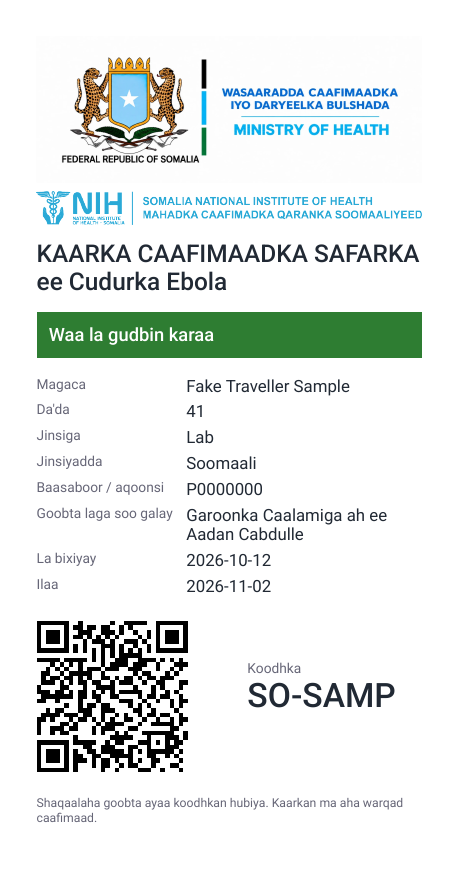
The Travel Health Pass issued to a traveller, with a single use code
The pass the traveller receives, in Somali, carrying the institutions' marks and a single use code.
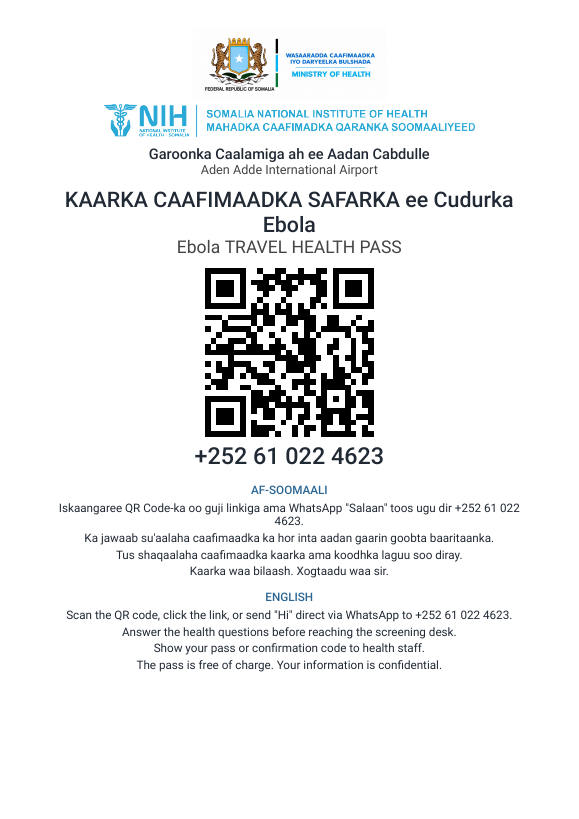
The poster at a point of entry, with the government number and instructions in both languages
The poster at each point of entry, generated by the system in the official name of that place.
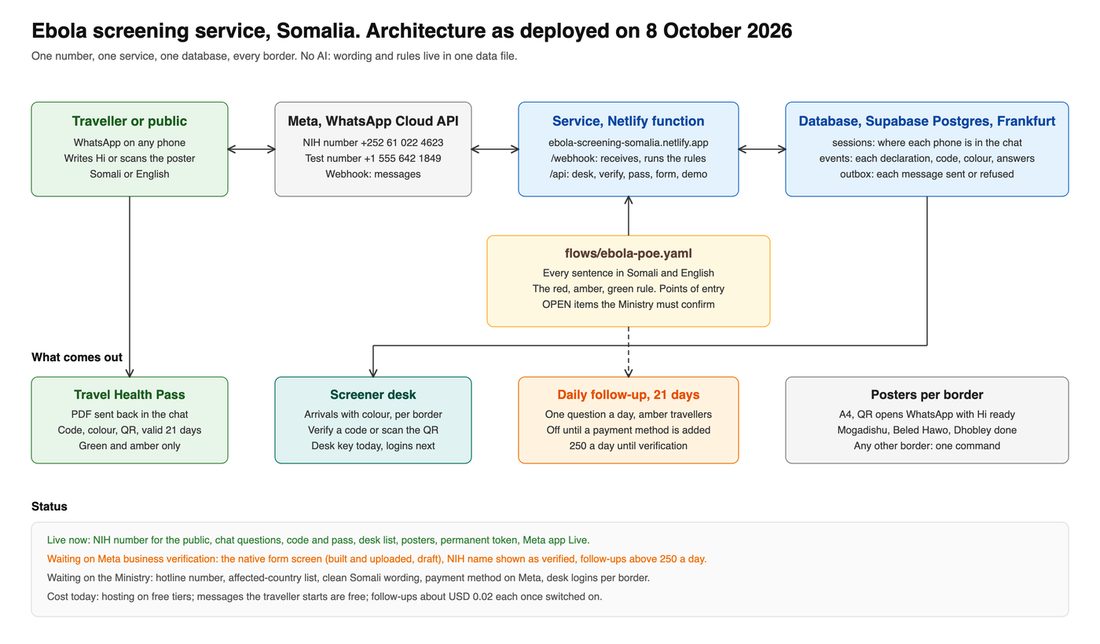
How the service is put together, from the traveller's phone to the screening desk
How it is put together, from the traveller's phone to the desk and the emergency centre.

We build to the standards the sector already agreed

A national health system is only as useful as the systems it can speak to. Building to a private format is how a ministry ends up locked in, to us or to anyone else.

DHIS2aggregate health reporting, because it is what most ministries in the region already run
HL7 FHIRexchanging client level data with electronic record systems instead of replacing them
WHO SMART Guidelinesthe reference when a clinical or public health rule has to be made computable
OpenMRS and Bahmniwhere a facility system is the right answer rather than something new
Open exportsevery export in an open format with the schema documented, readable without us

Talk to us

Tell us the problem in a paragraph. We answer the same week, with a view on whether we are the right firm for it.

Mogadishu, Somalia. Sunday to Thursday, 8:00 to 17:00.